

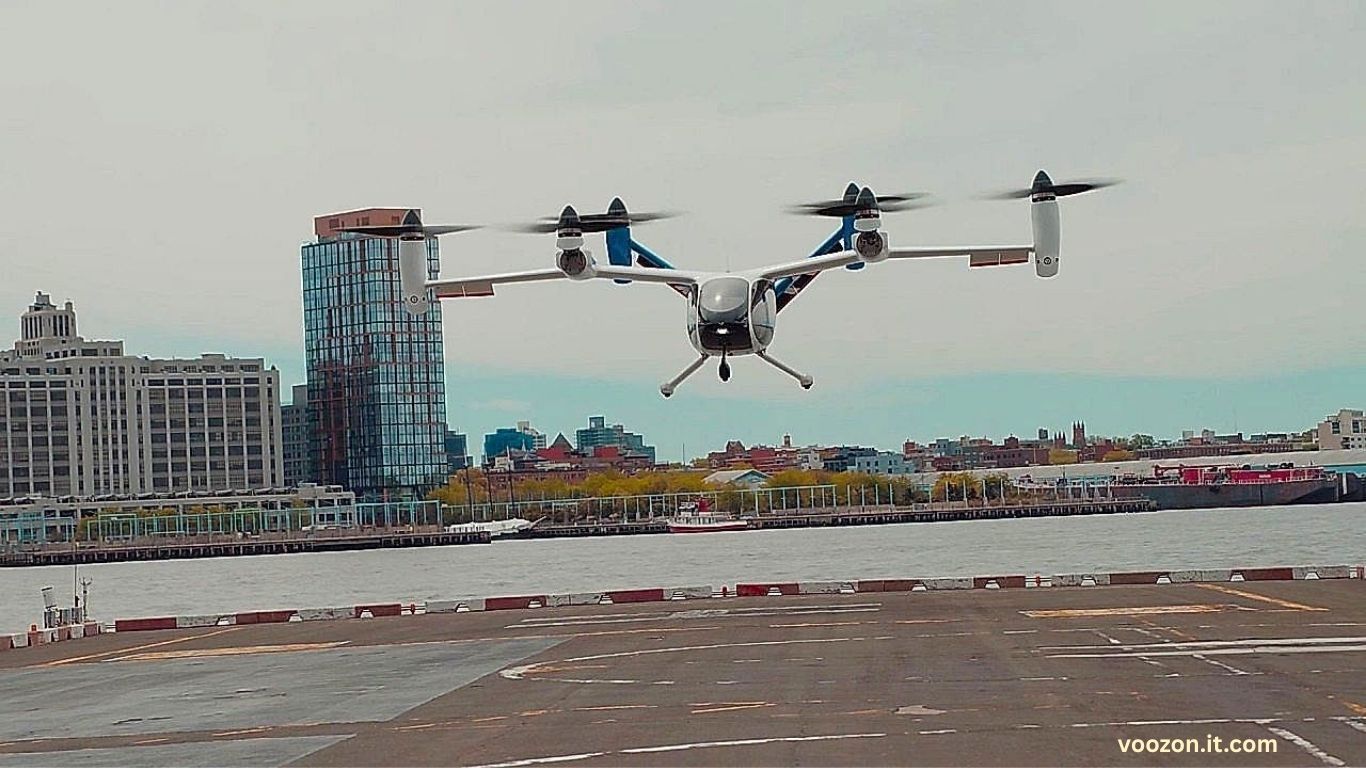
Idea of flying cars and airborne taxis belonged firmly to the realm of science fiction. Animated shows like The Jetsons painted a picture of a future where personal aircraft replaced automobiles, transforming city skylines into bustling aerial highways. That future, once imagined as a distant dream, is now beginning to take shape. In a landmark moment for urban mobility, a next-generation electric air taxi recently flew over New York City, offering a glimpse into what could become one of the most transformative developments in modern transportation.
The sight of this sleek, futuristic aircraft soaring above one of the world’s busiest cities was more than a technological demonstration—it was a symbol of how innovation is reshaping the way people may travel in the coming decades. With advancements in electric propulsion, autonomous systems, and sustainable aviation, air taxis are moving rapidly from concept to reality.
A Historic Moment for Urban Air Mobility
New York City has long served as a proving ground for groundbreaking transportation technologies. From the first subway systems to ride-sharing platforms, the city has often been at the forefront of mobility innovation. The recent demonstration flight of an electric vertical takeoff and landing (eVTOL) aircraft over NYC marks another important milestone.
The aircraft, often described as a real-world version of a Jetsons flying car, lifted off smoothly, maneuvered with remarkable quietness, and showcased capabilities that could redefine short-distance urban travel. Unlike traditional helicopters, which are noisy, expensive, and fuel-intensive, eVTOL aircraft are designed to operate using electric power. This makes them significantly quieter, more efficient, and environmentally friendly.
For observers on the ground, the flight represented more than a technical achievement. It offered a tangible preview of a future where commuting above congested streets may become an everyday reality.
Read more: My Grandmother Handed Me $2,000 for Graduation and Said, ‘Go to Europe.
What Exactly Is an Air Taxi?
An air taxi is a small, highly advanced aircraft designed to transport passengers over short distances, particularly within urban and suburban areas. Most modern air taxi designs fall under the eVTOL category, meaning they can take off and land vertically like a helicopter while flying efficiently like an airplane.
These aircraft typically feature multiple electric rotors, advanced battery systems, and sophisticated flight-control software. Some models are designed for piloted operation initially, while others are being developed for eventual autonomous flight.
The goal is straightforward: provide fast, efficient, and sustainable transportation for urban environments where road congestion continues to worsen.
Imagine traveling from Manhattan to JFK Airport in under 10 minutes rather than spending an hour or more in traffic. That is the promise air taxi developers are working to deliver.
Why New York City Matters
New York City is one of the most challenging and compelling markets for urban air mobility. With its dense population, chronic traffic congestion, and extensive network of existing heliports, the city presents an ideal environment for testing the viability of air taxi services.
A successful rollout in New York would serve as a powerful proof of concept for other major metropolitan areas around the world, including Los Angeles, London, Dubai, Singapore, and Tokyo.
The city’s infrastructure already supports helicopter operations, which could ease the transition to electric air taxis. Existing heliports may eventually be converted into specialized vertiports—dedicated hubs where air taxis can take off, land, recharge, and board passengers.
Such infrastructure would form the backbone of an entirely new transportation ecosystem.
The Technology Behind the Vision
The rapid development of air taxis has been made possible by several converging technological breakthroughs.
Electric Propulsion
Unlike conventional aircraft powered by jet fuel, eVTOLs rely on electric motors. These motors are not only cleaner but also far quieter. Reduced noise is critical for urban deployment, where community acceptance will play a major role in adoption.
Advanced Batteries
Battery technology has improved dramatically over the past decade. Higher energy density allows air taxis to achieve practical flight ranges while maintaining safety and performance standards.
Autonomous Systems
Although early commercial services will likely include human pilots, automation will play a significant role. Advanced navigation, collision avoidance, and flight management systems are expected to enhance safety and operational efficiency.
Lightweight Materials
Modern composites and advanced manufacturing techniques help reduce aircraft weight while maintaining structural integrity. This improves range, efficiency, and payload capacity.
Environmental Benefits
One of the strongest arguments in favor of air taxis is their potential environmental impact. Transportation remains a major source of greenhouse gas emissions worldwide. Electric air taxis offer a cleaner alternative for short-haul travel.
By eliminating direct emissions during flight, eVTOLs could significantly reduce the carbon footprint associated with urban transportation. When powered by renewable energy sources, their environmental advantages become even greater.
Additionally, their lower noise levels make them far more compatible with densely populated urban areas than traditional helicopters.
As cities around the world pursue ambitious climate goals, electric aviation could become an essential part of sustainable transportation strategies.
Challenges Still Ahead
Despite the excitement, widespread adoption of air taxis will not happen overnight. Several critical challenges must still be addressed.
Regulatory Approval
Aviation regulators, including the Federal Aviation Administration (FAA), must certify these aircraft for commercial operation. This process is rigorous and essential for ensuring passenger safety.
Infrastructure Development
Cities will need to build vertiports, charging stations, and air traffic management systems capable of supporting large-scale eVTOL operations.
Public Acceptance
Consumers must feel confident in the safety, reliability, and affordability of air taxi services. Public trust will be a decisive factor in adoption.
Cost and Scalability
Initial services are expected to be premium offerings. Over time, economies of scale and technological improvements should make air taxis more accessible to a broader audience.
Who Is Leading the Race?
Several major companies are competing to become leaders in the emerging urban air mobility market. Industry pioneers include companies such as entity[“company”,”Joby Aviation”,”eVTOL manufacturer”], entity[“company”,”Archer Aviation”,”eVTOL manufacturer”], entity[“company”,”Volocopter”,”German eVTOL company”], and entity[“company”,”Lilium”,”German aviation company”].
These firms have attracted billions of dollars in investment from automakers, airlines, venture capital firms, and strategic partners. Their prototypes have already completed numerous successful test flights, bringing commercial launch timelines closer.
Partnerships with airlines and airport operators are also accelerating development, particularly for airport shuttle services.
The Passenger Experience
Flying in an air taxi is expected to feel very different from traditional aviation. Cabins are being designed with comfort, simplicity, and convenience in mind.
Passengers may book flights through mobile apps, much like ride-sharing services today. After arriving at a vertiport, they would undergo streamlined security procedures before boarding.
The flight itself would be smooth, quiet, and remarkably efficient. Large windows, spacious seating, and panoramic city views could transform routine commutes into memorable experiences.
For business travelers, tourists, and commuters alike, air taxis could offer an entirely new way to experience urban travel.
Economic Implications
The emergence of air taxis could create substantial economic opportunities. New industries, jobs, and infrastructure projects are likely to arise around urban air mobility.
Potential areas of growth include:
- Aircraft manufacturing
- Battery production
- Vertiport construction and operations
- Software development
- Air traffic management services
- Maintenance and support operations
Analysts predict that the urban air mobility market could be worth hundreds of billions of dollars over the coming decades.
Cities that embrace this technology early may gain significant economic and competitive advantages.
A Glimpse Into Tomorrow
The first sight of an air taxi flying over New York City was more than a spectacle—it was a preview of how transportation may evolve in the 21st century. Just as automobiles transformed cities in the last century, electric air taxis could redefine mobility in the next.
While regulatory, technical, and infrastructure hurdles remain, progress is accelerating at an impressive pace. What once seemed like fantasy is quickly becoming an engineering and commercial reality.
The skies above our cities may soon host a new layer of transportation—one that is cleaner, quieter, and dramatically more efficient.
Frequently Asked Questions
What is an air taxi?
An air taxi is a small aircraft designed for short-distance travel, especially in urban areas. Most are electric vertical takeoff and landing (eVTOL) vehicles that can operate like both helicopters and airplanes.
How does an air taxi work?
Air taxis use multiple electric rotors for vertical takeoff and landing. Once airborne, they transition into forward flight, allowing for efficient, fast, and quiet travel.
Are air taxis safe for passengers?
Yes, safety is the top priority. Air taxis are being developed with advanced navigation systems, redundant safety features, and must undergo strict certification by aviation authorities before commercial use.
When will air taxis become commercially available?
Several companies aim to launch commercial air taxi services between 2026 and 2030, depending on regulatory approvals, infrastructure development, and market readiness.
How much will an air taxi ride cost?
Initially, air taxi rides are expected to be priced at a premium, similar to helicopter services or luxury ride-sharing. Over time, costs are likely to decrease as the technology scales.
What are the environmental benefits of air taxis?
Because they are powered by electricity, air taxis produce zero direct emissions during flight. They are also significantly quieter than traditional helicopters, making them more suitable for urban environments.
Which companies are leading the air taxi industry?
Major players include Joby Aviation, Archer Aviation, Volocopter, and Lilium, all of which are actively developing commercial eVTOL aircraft.
Conclusion
The future of aviation is no longer a distant concept. It is already taking flight. The successful demonstration of a Jetsons-like air taxi over New York City signals the beginning of a new era in urban transportation. As electric aviation technology matures, air taxis have the potential to revolutionize how people move through crowded cities. They promise faster commutes, reduced emissions, and a fundamentally new travel experience.
