

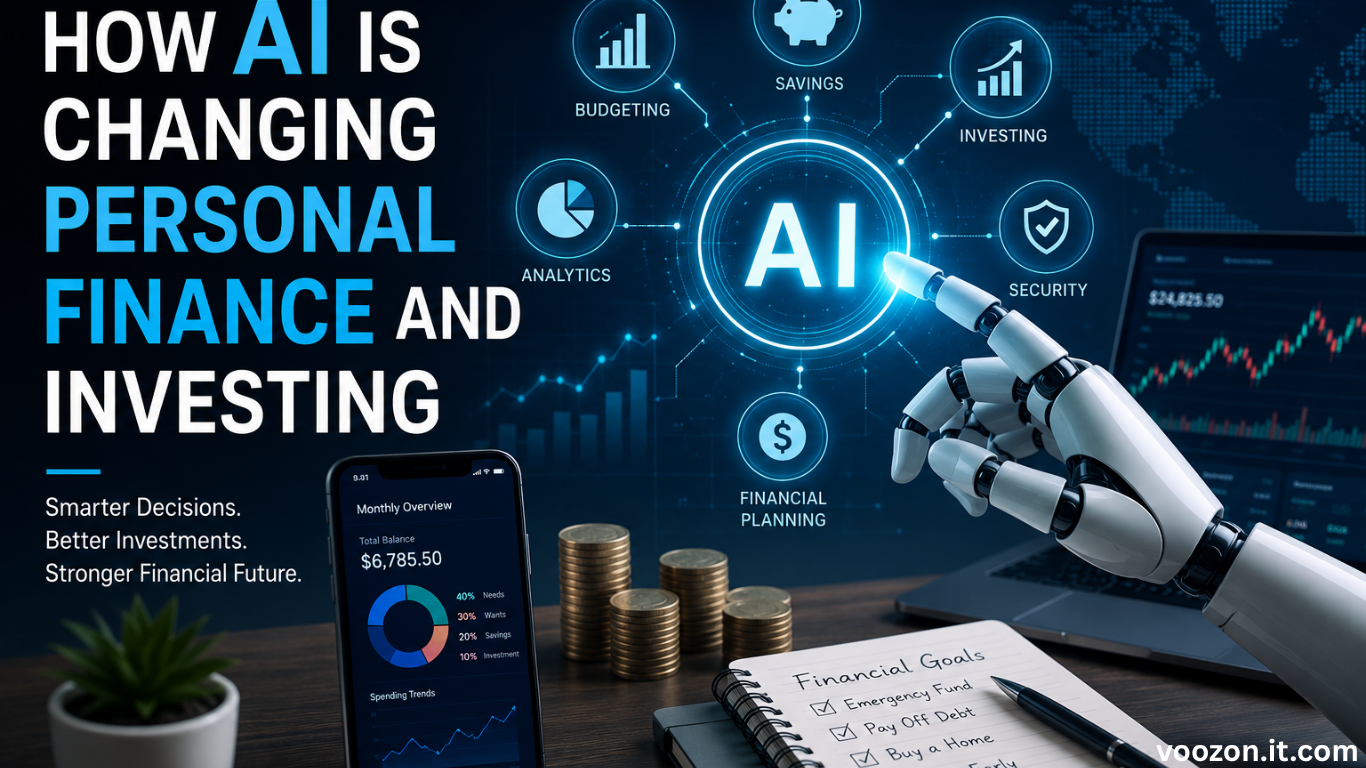
Personal Finance has entered a new era, thanks to the rapid advancement of artificial intelligence (AI). From budgeting apps and automated savings tools to intelligent investment platforms, AI is transforming how individuals manage money, make financial decisions, and build wealth. What once required financial advisors, extensive research, and years of experience can now be achieved with AI-powered solutions that analyze data within seconds.
The growing adoption of AI in personal finance and investing is making financial management more accessible, accurate, and personalized than ever before. Whether someone is planning a monthly budget, improving their credit score, investing in stocks, or preparing for retirement, AI offers valuable insights and automation that simplify complex financial tasks. As technology continues to evolve, understanding AI’s impact on personal finance has become essential for anyone seeking long-term financial success.
What Is Artificial Intelligence in Personal Finance?
Artificial intelligence in personal finance refers to computer systems that use machine learning, predictive analytics, and data processing to assist individuals in managing their finances. Unlike traditional financial software that simply records transactions, AI can analyze spending patterns, predict future expenses, recommend investment strategies, and even detect fraudulent activities.
Modern AI systems continuously learn from user behavior, making their recommendations increasingly accurate over time. Instead of offering generic financial advice, AI delivers customized guidance based on income, spending habits, financial goals, and market conditions.
This personalized approach has made financial planning more efficient and accessible to people regardless of their financial knowledge.
The Evolution of Financial Management Through AI
Financial management has changed dramatically over the last two decades.
Previously, individuals relied on spreadsheets, paper records, or financial advisors to manage money. Investment decisions often required professional expertise, while budgeting depended heavily on manual tracking.
Today, AI automates many of these responsibilities.
Modern financial platforms can:
- Categorize expenses automatically
- Predict monthly bills
- Suggest savings opportunities
- Monitor subscriptions
- Analyze investment portfolios
- Detect unusual account activity
- Forecast financial trends
This evolution allows individuals to spend less time managing finances while making smarter financial decisions.
AI-Powered Budgeting Tools
One of AI’s biggest contributions to personal finance is intelligent budgeting.
Traditional budgeting requires manually recording expenses and comparing them against income. AI eliminates much of this effort through automation.
AI budgeting tools can:
Automatically Categorize Transactions
Every purchase is classified into categories such as:
- Groceries
- Transportation
- Entertainment
- Utilities
- Healthcare
- Dining
This provides users with a clear overview of where their money is going.
Analyze Spending Behavior
AI identifies spending patterns over weeks and months.
For example, it may detect that someone spends significantly more on online shopping during weekends or spends more on restaurants than groceries.
Such insights help users make informed financial adjustments.
Predict Future Expenses
By analyzing recurring payments and seasonal spending habits, AI forecasts upcoming expenses before they occur.
This proactive approach helps users avoid financial surprises.
Recommend Budget Improvements
Rather than simply reporting spending, AI actively suggests practical ways to reduce unnecessary expenses and increase savings.
Smarter Saving With AI
Saving money is often difficult because many individuals struggle with consistency.
AI addresses this challenge through automated savings strategies.
Intelligent Savings Automation
AI studies cash flow and determines how much money can safely be transferred into savings without affecting daily expenses.
Small automated transfers accumulate over time, encouraging consistent saving habits.
Personalized Savings Goals
AI allows users to establish financial goals such as:
- Emergency funds
- Vacation planning
- Home purchases
- Education expenses
- Vehicle replacement
The system tracks progress and recommends adjustments whenever necessary.
Spending Alerts
When spending exceeds normal patterns, AI immediately sends notifications, helping users stay within their financial plans.
AI and Investment Management
Perhaps the most significant impact of AI has been in investing.
Investment decisions traditionally depended on extensive research and professional financial advisors.
AI has changed this completely.
Robo-Advisors
AI-powered robo-advisors create and manage investment portfolios based on:
- Risk tolerance
- Age
- Income
- Investment goals
- Time horizon
These platforms automatically rebalance portfolios to maintain the desired asset allocation.
Portfolio Optimization
AI constantly evaluates investment performance.
If certain investments become too risky or underperform, AI recommends adjustments to improve long-term returns.
Market Analysis
Artificial intelligence can process enormous volumes of market data far faster than humans.
It analyzes:
- Company earnings
- Economic reports
- Interest rates
- Inflation
- Market sentiment
- Global events
These insights help investors make better-informed decisions.
Predictive Analytics in Investing
Predictive analytics has become one of AI’s strongest capabilities.
Instead of merely reporting historical performance, AI attempts to forecast future market behavior using statistical models and machine learning.
Although predictions are never guaranteed, AI can identify trends that humans may overlook.
Examples include:
- Identifying undervalued stocks
- Predicting sector growth
- Detecting market volatility
- Estimating investment risks
- Forecasting economic changes
These capabilities support more strategic investment planning.
AI in Stock Market Research
Researching individual stocks traditionally required hours of reading financial statements and news reports.
AI dramatically accelerates this process.
It analyzes:
- Quarterly earnings
- Balance sheets
- Cash flow
- Industry performance
- News articles
- Social media sentiment
- Analyst opinions
Within seconds, AI summarizes important findings, allowing investors to evaluate opportunities more efficiently.
Personalized Financial Advice
Financial planning is no longer limited to wealthy individuals.
AI makes personalized financial guidance available to almost everyone.
Based on user information, AI can recommend:
- Debt reduction strategies
- Retirement savings plans
- Investment allocations
- Insurance considerations
- Emergency fund targets
- Tax-saving opportunities
The advice continually evolves as financial situations change.
Debt Management Through AI
Managing debt is another area where AI delivers measurable benefits.
AI evaluates:
- Interest rates
- Loan balances
- Monthly payments
- Credit utilization
- Payment history
It then recommends repayment strategies such as:
Debt Avalanche Method
Prioritize loans with the highest interest rates first.
Debt Snowball Method
Focus on paying smaller balances first to build motivation.
AI calculates which strategy best fits each individual’s financial situation.
AI and Credit Score Improvement
Credit scores significantly affect borrowing costs and financial opportunities.
AI helps improve credit health by:
- Monitoring payment history
- Tracking credit utilization
- Identifying reporting errors
- Recommending payment schedules
- Alerting users before due dates
Some AI systems even simulate how financial decisions may influence future credit scores.
Fraud Detection and Financial Security
Security has become increasingly important in digital banking.
AI plays a major role in protecting financial accounts.
Real-Time Fraud Detection
AI continuously monitors transactions for unusual behavior.
Examples include:
- Unexpected foreign purchases
- Large withdrawals
- Suspicious login attempts
- Unusual spending locations
When anomalies are detected, immediate alerts help prevent financial losses.
Behavioral Authentication
Some financial institutions use AI to recognize normal user behavior, including:
- Typing patterns
- Login frequency
- Device usage
- Transaction timing
This adds another layer of protection against fraud.
AI in Retirement Planning
Planning for retirement involves complex calculations.
AI simplifies retirement planning by estimating:
- Future income needs
- Inflation effects
- Investment growth
- Expected retirement age
- Required savings
These projections help individuals stay on track toward long-term financial security.
Tax Planning With Artificial Intelligence
Tax preparation often feels overwhelming.
AI assists by:
- Organizing financial records
- Identifying deductions
- Tracking business expenses
- Estimating tax liabilities
- Reducing filing errors
Some systems also suggest tax-saving strategies throughout the year rather than only during tax season.
AI and Cryptocurrency Investing
Artificial intelligence has become increasingly important in cryptocurrency markets.
Since digital assets experience rapid price fluctuations, AI analyzes:
- Trading volume
- Market sentiment
- Historical trends
- Blockchain activity
- Price momentum
Investors use these insights to improve timing and risk management.
However, cryptocurrency remains highly volatile, and AI cannot eliminate investment risk.
Benefits of AI in Personal Finance
AI offers numerous advantages for financial management.
Greater Accuracy
Automated calculations reduce human errors.
Faster Decision-Making
Large datasets are analyzed within seconds.
Personalization
Recommendations match individual financial situations.
Better Financial Awareness
Users gain deeper insights into spending habits and saving opportunities.
Lower Costs
Many AI-powered financial services cost less than traditional financial advisors.
Continuous Monitoring
AI works around the clock without interruption.
Challenges and Limitations
Despite its advantages, AI has certain limitations.
Data Privacy Concerns
Financial applications require access to sensitive personal information.
Users should carefully evaluate privacy policies before sharing financial data.
Market Uncertainty
AI predictions rely on historical data and statistical models.
Unexpected global events may reduce prediction accuracy.
Algorithm Bias
Poor-quality data can produce biased recommendations.
Developers must continuously improve AI systems to ensure fairness.
Overreliance on Automation
AI should support financial decisions rather than replace human judgment completely.
Critical investment choices still require careful evaluation.
The Future of AI in Personal Finance
Artificial intelligence continues to evolve rapidly.
Future innovations may include:
Hyper-Personalized Financial Planning
AI will deliver even more customized recommendations based on life events and changing financial goals.
Voice-Based Financial Advisors
Users may interact naturally with AI assistants for real-time financial guidance.
Advanced Investment Intelligence
Machine learning models will continue improving portfolio optimization and market analysis.
Improved Financial Education
AI will help individuals better understand investing through personalized learning experiences.
Greater Accessibility
Affordable AI financial services will become available to larger populations worldwide.
Best Practices for Using AI in Finance
To maximize the benefits of AI:
- Choose reputable financial platforms.
- Review AI recommendations before acting.
- Diversify investments instead of relying on a single strategy.
- Monitor financial goals regularly.
- Protect personal financial information with strong security measures.
- Stay informed about changing financial markets.
- Combine AI insights with professional advice for major financial decisions.
How AI Is Empowering Everyday Investors
One of the greatest achievements of artificial intelligence is democratizing investing.
Individuals no longer need extensive financial education or significant wealth to begin investing confidently.
AI simplifies research, automates portfolio management, explains complex financial concepts, and provides real-time insights that were once available only to professional investors.
This accessibility encourages more people to participate in long-term wealth creation while reducing many of the barriers that previously discouraged beginners.
As AI technology becomes even more sophisticated, everyday investors will likely gain access to increasingly advanced financial tools that improve confidence and decision-making.
Conclusion
Personal Finance is being transformed by artificial intelligence in ways that were unimaginable just a few years ago. AI has revolutionized budgeting, saving, investing, debt management, fraud detection, retirement planning, and financial education by making these processes more efficient, personalized, and data-driven. While AI cannot guarantee financial success or eliminate investment risks, it provides valuable insights that help individuals make more informed decisions. As technology continues to evolve, combining AI-powered tools with sound financial knowledge and responsible decision-making will enable individuals to build stronger financial futures, achieve long-term wealth, and confidently navigate an increasingly digital financial world.
